Modern IT environments don’t suffer from a lack of data—they suffer from fragmentation.
Monitoring tools, ITSM platforms, dashboards, logs, and performance systems all operate in silos. Even with Microsoft System Center Operations Manager (SCOM), getting a complete picture often requires jumping between tools, writing queries, and manually correlating information.
This is one of the key problems the Silect Assistant was designed to solve.
What makes the Silect Assistant truly powerful isn’t just what it does out of the box—it’s how easily it can be extended.
The Foundation: MCP Client + MCP Server for SCOM
At its core, the Silect Assistant is built on a simple but powerful architecture:
- MCP Client – embedded within the Assistant, responsible for interpreting user intent and orchestrating actions
- MCP Server for SCOM – exposes SCOM data and operations as secure, callable tools
This model allows the Assistant to translate natural language into real, actionable operations:
- Retrieve alerts
- Analyze performance data
- Investigate root cause
- Execute operational workflows
All without requiring users to write SQL, navigate multiple consoles, or manually correlate data.
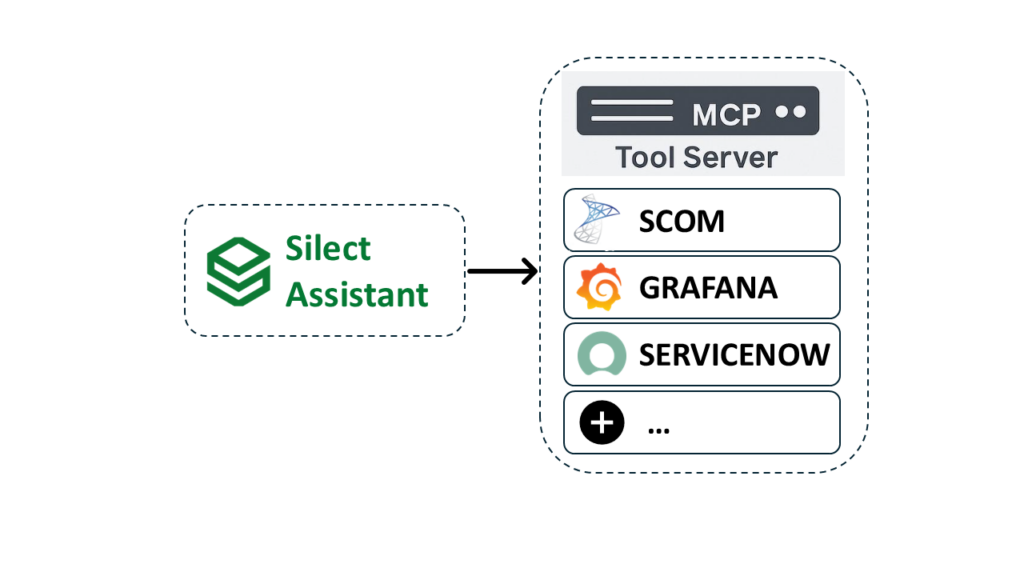
The Real Power: Adding More MCP Servers
The Silect Assistant isn’t limited to SCOM.
Because it uses the Model Context Protocol (MCP), you can extend its capabilities simply by adding additional MCP servers.
Each MCP server becomes a new domain of intelligence and action.
Think of it as turning the Silect Assistant into a central AI control plane for your IT operations ecosystem.
What Can You Extend?
By introducing additional MCP servers, you can connect the Silect Assistant to virtually any system in your environment.
IT Service Management (ITSM)
Integrate platforms like ServiceNow to:
- Enrich incidents with real-time monitoring data
- Automatically correlate alerts with tickets
- Suggest resolutions based on historical patterns
Observability & Dashboards
Extend into tools like Grafana to:
- Pull live dashboard context into conversations
- Analyze trends across multiple data sources
- Provide deeper insight into performance anomalies
Cloud & Infrastructure APIs
Connect to cloud platforms and infrastructure tools to:
- Query resource health
- Trigger automation workflows
- Perform remediation actions
Internal Tools & Custom Systems
Expose your own APIs and internal services as MCP tools:
- CMDB queries
- Deployment pipelines
- Configuration systems
- Security tools
A Unified Experience for IT Operations
Once multiple MCP servers are connected, something powerful happens:
The Silect Assistant becomes a single conversational interface across your entire IT stack.
Instead of asking:
- “What alerts are active in SCOM?”
- “Is there a ServiceNow incident for this?”
- “What does Grafana show for this system?”
You simply ask: “What’s going on with this issue, and what should I do next?”
And the Assistant:
- Pulls alerts from SCOM
- Checks for related incidents
- Analyzes performance trends
- Recommends next steps
All in one place.
Built for Security and Control
Extensibility doesn’t come at the cost of control.
Each MCP server:
- Runs where your data lives (on-prem or cloud)
- Enforces its own authentication and authorization
- Exposes only the tools and data you choose
This aligns perfectly with the Silect Assistant’s core design principle:
Secure AI, deployed your way.
A Platform, Not Just a Feature
With MCP, the Silect Assistant evolves from a SCOM-focused solution into something much bigger:
- A framework for integrating AI into IT operations
- A standardized way to expose tools and data to AI systems
- A foundation for building intelligent, automated workflows
You’re not just deploying a product—you’re building an extensible AIOps platform.
Getting Started
If you’re already using the Silect Assistant with SCOM, extending it is straightforward:
- Identify the systems you want to integrate
- Expose their capabilities via MCP servers
- Connect them to the Silect Assistant
- Start interacting through natural language
The result is immediate: more context, better insights, and faster resolution.
Final Thoughts
The future of IT operations isn’t about adding more tools.
It’s about connecting them.
By leveraging MCP and extending the Silect Assistant with additional MCP servers, you can break down silos, unify your data, and bring true intelligence to your operations.